The problem
Many businesses win customers through search, and search rewards sites that publish useful, specific content consistently. Writing that content by hand is slow and expensive. Generic AI writing is fast but thin, repetitive and easy for Google to ignore.
The goal was a system that produces content good enough to rank, at a cost that makes sense, and keeps doing it without someone babysitting it.
The websites these pipelines run for are not named here, out of respect for the businesses behind them.
How a post is made
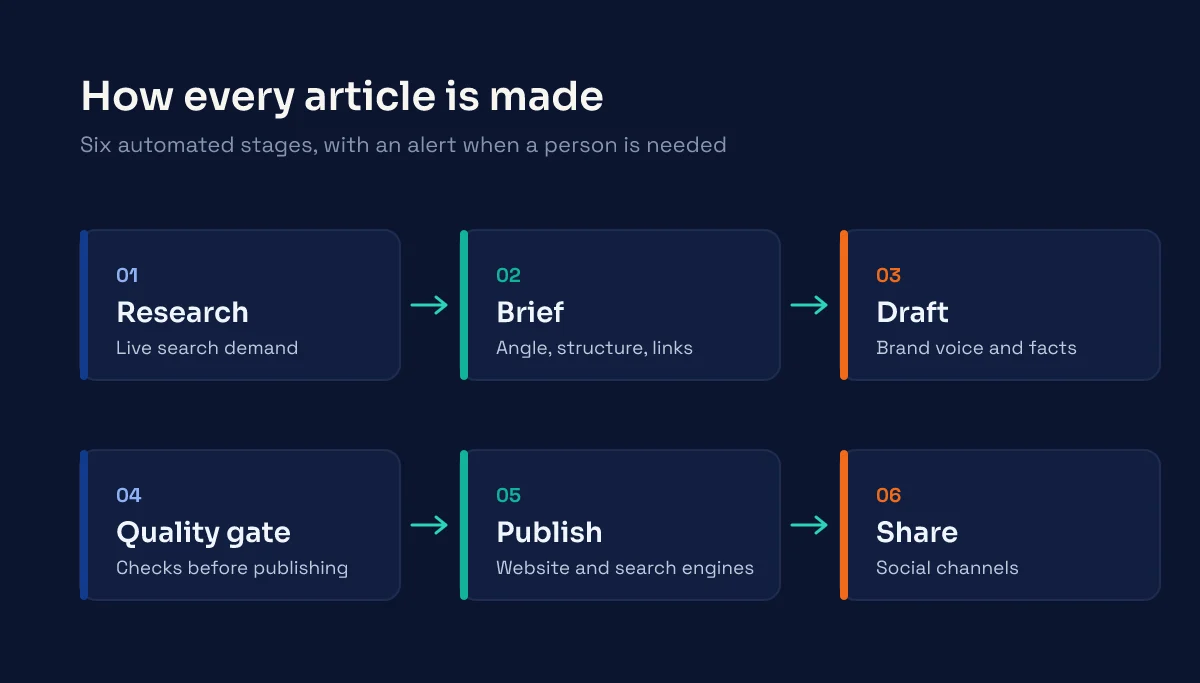
- Pick a topic from real demand. Topics come from live keyword data (search volume, difficulty and what already ranks), balanced so a site does not repeat itself.
- Brief and draft. A brief sets the angle, structure and internal links, then the article is drafted against it with the site's own voice, products and facts.
- Quality gate. Every draft is checked before it can go live: structure, length for its article type, title and meta description limits, banned phrases and out-of-date years. Drafts that fail are rewritten or held.
- Publish. Passing articles go to WordPress through its API with images, links and a call to action, and search engines are notified straight away.
- Share. Social posts are written for each platform and scheduled to the site's own channels.
- Report. A notification reaches my phone for every published post, every held draft and anything that breaks.
Keeping quality up
The hardest part of AI content is not writing, it is noticing when the writing is wrong. Most of my time on this system went into the quality gate: catching the cases where a model fixes one thing and quietly breaks another, holding articles that mention a past year as if it were current, and making sure each type of article is judged by its own length and structure rules.
In October 2026 I moved every pipeline onto one shared codebase. Each site now differs only in its configuration (voice, products, menu and search property), and a nightly check alerts me if any site's code drifts from the shared version.
Keeping costs down
Every post costs real money in AI calls and keyword data, so cost is tracked per post. Caching keyword lookups and reusing research across related articles roughly halved the daily keyword-data bill in September 2026. A typical post now costs around two US cents in AI and data calls.
Results
Live clicks and impressions are on the results page, pulled straight from Google Search Console.